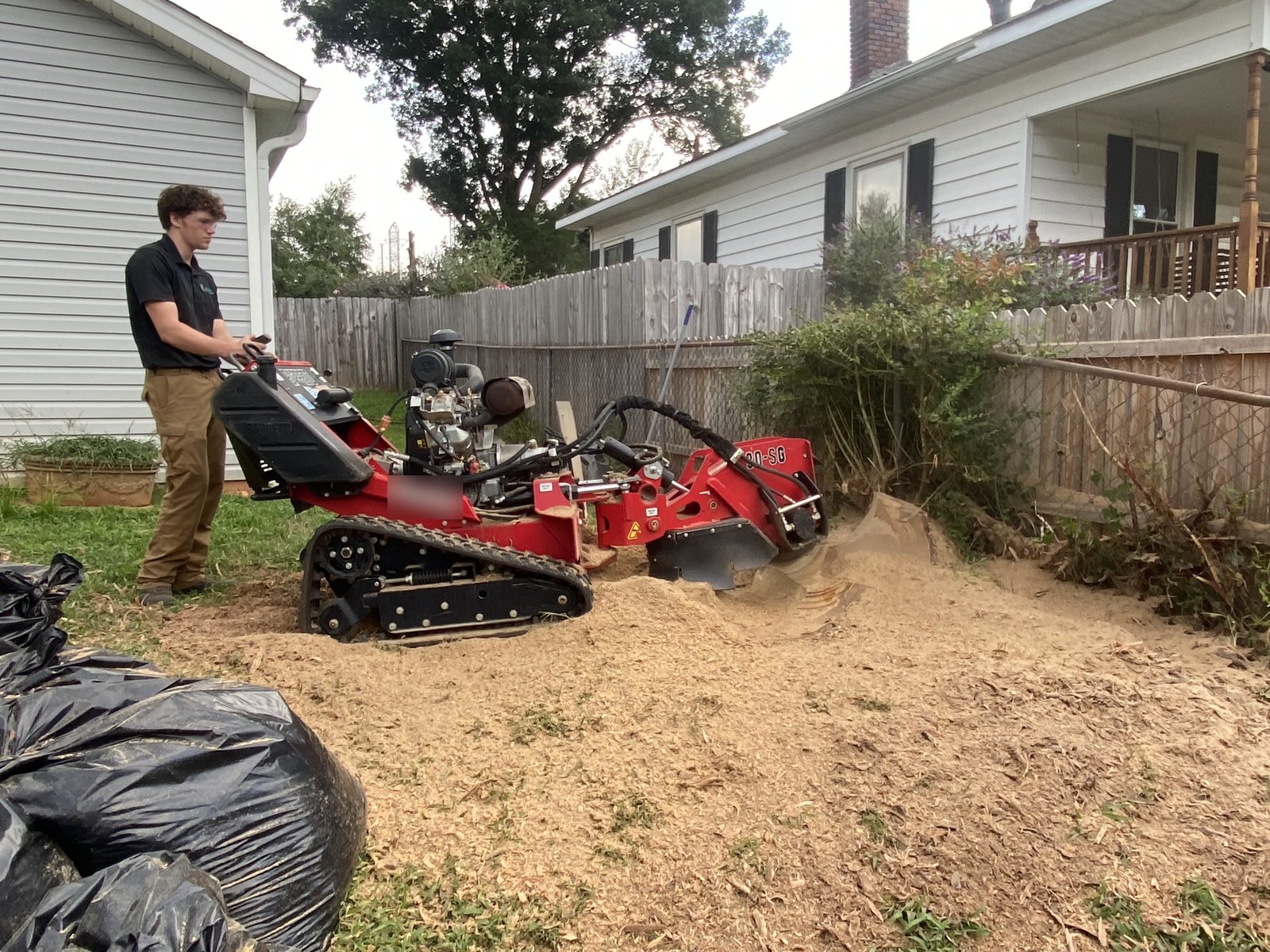
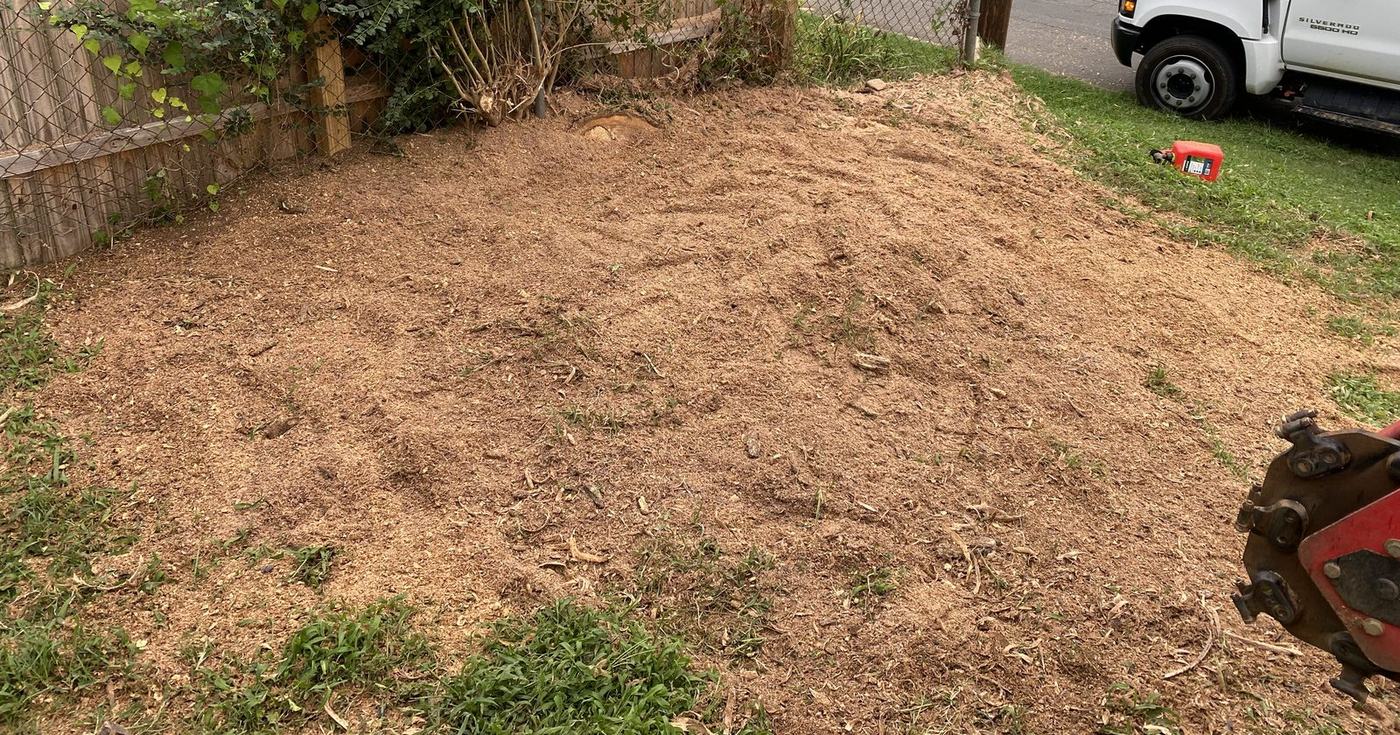
Stump grinding for Charlotte yards β big hardwood stumps in old neighborhoods, roots under sidewalks and drives, backyard stumps through the side gate. Ground below grade, hauled or backfilled. Flat quotes.
Charlotte's stumps are the ones the tree crew left. A willow oak that came down in Myers Park or Dilworth leaves a stump the size of a dining table with roots that have already lifted the sidewalk and cracked the driveway. A row of Leyland cypress along a Ballantyne fence leaves a dozen smaller ones in a line. We grind them below grade, chase the roots that are doing damage, and leave the spot ready to sod or plant β through the side gate, without turning the front yard into a job site.
Ranges for the big old-neighborhood stumps and the fence-line sets we see in the city. The cost guide has more; a photo usually gets you a firm number.
Flat, in writing, from a look or a photo. Never hourly.
The city's older neighborhoods were planted with big trees a long time ago β the willow oaks that line Queens Road and Dilworth's streets are the famous ones, but every block in Elizabeth, Eastover and Sedgefield has hardwoods of that age. When one comes out, the stump is large, the root plate is wide, and the roots have had decades to find the sidewalk, the driveway, the foundation and the sewer lateral. Grinding a stump like that is less about the stump than about the roots: which ones are lifting the concrete, how far they run, and how deep we can chase them without hitting something that matters.
The soil is red clay, which makes grinding slower than in sandy ground but keeps the roots shallow and easy to find. It also means the hole a big stump leaves fills with water if it's just left; we backfill with the grindings mixed with clay and compact it so the spot doesn't become a sinkhole in the lawn a year later.
The other Charlotte pattern is volume in small yards: a fence line of cypress or a cluster of crepe myrtles that all came out at once. Those are quick individually and priced as a set, and the job is mostly about moving the grinder along a tight line without damaging the fence.
The calls come from the oak neighborhoods first β Myers Park, Eastover, Dilworth, Plaza Midwood, Elizabeth β usually within a few weeks of a storm that brought a big tree down and a week after the tree crew left the stump. The second wave is subdivision work in Ballantyne, Blakeney and the University area: rows of cypress, Bradford pears that split, crepe myrtles that got too big for the bed.

The grinder goes through any 8 ft gate, and on most Charlotte lots that's the route: down the side yard, into the back, around the patio. We protect the lawn on the way in and out, and on a lot where the only route is across fresh sod or a soft yard we'll say so before we start rather than leave tracks.
Stumps near the street come with utilities. Gas, water and sometimes fiber run under Charlotte parkways and front yards, and a root that's lifting the sidewalk may be wrapped around a service line. We have utilities located before grinding anywhere near the right-of-way, and we grind shallower where a line is close rather than gamble. Stumps against a foundation or a retaining wall get the same treatment β depth is set by what's next to them.
Grindings are either hauled or used as backfill. On a small Charlotte lot there's usually no room for a pile, so we haul them to yard-waste disposal inside Mecklenburg County the same day, or blend them into the hole with clay and compact so the spot can be seeded.
Old stumps behave differently from fresh ones. A willow oak stump that's been sitting for a few years has softened and grinds quickly but has usually started to sink, leaving a hollow that fills with water in Charlotte clay. A fresh stump is harder work but a cleaner hole. Either way the finish is the same: backfilled, compacted, ready to seed.
A stump on your own lot needs no permit. A stump in the strip between the sidewalk and the street is in the City of Charlotte's right-of-way, and the city has an interest in what happens there β including what's planted back. If your stump is in that strip we tell you before we grind, and we handle whatever the city needs at cost. No permit is required for grinding behind the sidewalk on a residential lot.
If a permit turns out to be required, we pull it ourselves and pass the city or county fee through unchanged. There is no markup and no handling charge on it.

Send a photo or we walk the yard within a few days β stump size, root spread, what's nearby, and the route through the gate.
One written number by the next business day, per stump or for the set. Haul or backfill stated up front.

Utilities located where needed, grinder through the side gate, stump below grade and damaging roots chased out.

Hole backfilled and compacted, grindings hauled or blended in, lawn protected on the way out.
Stumps come out because something's going in β a fence, a pad, a driveway extension, a cleared side yard. The same crew that grinds the stumps does the grading and the rest, on the same visit when the scope allows.
Send the address and what you're dealing with. We'll walk it within a few days and hand you a flat, all-in number.
π(980) 351-5115Tap to call Β· A real owner picks up Β· Site walk within a few days